Surface Analysis
The Surface Analysis Platform is composed of two groups of instruments:
- A setup of instrument combined under Ultra-High Vacuum (UHV):
- XPS (X-ray Photoelectron Spectroscopy)
- ToF-SIMS (Time-of-Flight Secondary Ion Mass Spectroscopy)
- LEIS (Low Energy Ion Scattering)
- High temperature treatment chamber
- A Near Ambient Pressure XPS (NAP-XPS) instrument
Surface analysis request form:
Please download the form here: FR |EN and send it fully completed at: pole-analyse-de-surfaces_at_univ-lille.fr
Samples can be sent to the address below:
Pôle Analyse de surface
Institut Chevreul FR CNRS 2638
Avenue Paul Langevin – bâtiment Chevreul
Cité Scientifique
59655 Villeneuve d’Ascq cedex
France
Staff:
- Jean-François Paul (Scientific Head of the Cluster)
- Pardis Simon (Technical Head: XPS, NAP-XPS)
- Nicolas Nuns (Technical Head: TOF-SIMS, LEIS)
- Guillaume Cochez (XPS)
Member of SFV Division Spectroscopies d’Électrons
Member of Fédération de Recherche Spectroscopies de PhotoEmission (FR SPE)
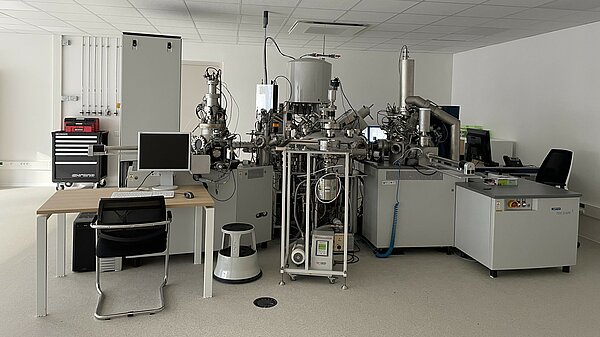
Combined XPS | ToF-SIMS | LEIS | High temperature treatment chamber setup
– The three spectrometers and the high temperature treatment cell are combined under ultra-high vacuum using a radial distribution chamber
– Sample holders are adapted for transfer between the 4 instruments.
KRATOS AXIS UltraDLD (2009) instrument
X-ray Photoelectron Spectroscopy (XPS) is a powerful technique that combines the advantages of chemical and elemental specificity, high surface sensitivity and quantitative analysis of the surface composition. XPS technique is based on the photoelectrical effect. Under Ultra High Vacuum (UHV), an X-ray source (with a given photon energy, hn) is used to illuminate a sample surface. Photoionized electrons from valence and core levels are then analyzed by an electron analyzer. The X‐ray induced photoelectron spectrum is then obtained as photoelectrons intensity versus their kinetic energy.
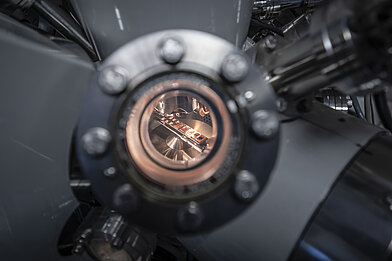
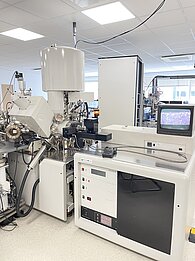
The depth of analysis is around 5 nm, the sensitivity around 0.5 atomic % and most samples can be analyzed in a non-invasive or non-destructive method.
XPS imaging mode give also access to surface mapping to provide lateral distribution maps of elemental and chemical species at the surface. The lateral resolution is 15 to 100 microns.
-
Kratos Axis Ultra DLD specifications
– Monochromated X-ray source Al Kα X-radiation (1486.6 eV)
– Dual anode Al Kα X-radiation (1486.7 eV) and Mg Kα X-radiation (1253.6eV)
– Hybrid magnetic and electrostatic lens system Hemispherical analyzer
– Area of analysis selection via aperture: 300 µm ´ 700 µm, 110 µm, 55 µm, 27 µm or 15 μm
– Electron detection and counting with a 2D Multi Channel Plate – delay line detector (DLD).
– 4-axis sample stage (x, y, z, θ) allowing angle-resolved studies for non-destructive depth profiling
– Temperature controlled sample stage with a range of -100 to 600 °C
– 5 keV Ar+ source for depth profiling and surface cleaning
– Charge neutralization system – analysis of insulators to prevent sample charging
-
Sample submission
– Samples that can be analyzed by XPS include: Catalyst powders, polymers, steels and metallic alloys, thin films, solid foam…
– Maximum sample sizes (l x w x h): 80 mm x 30 mm x 4 mm
– Samples must be stable down to 2.10-10 mbar
– Sample holders are adapted for ToF-SIMS and LEIS analysis
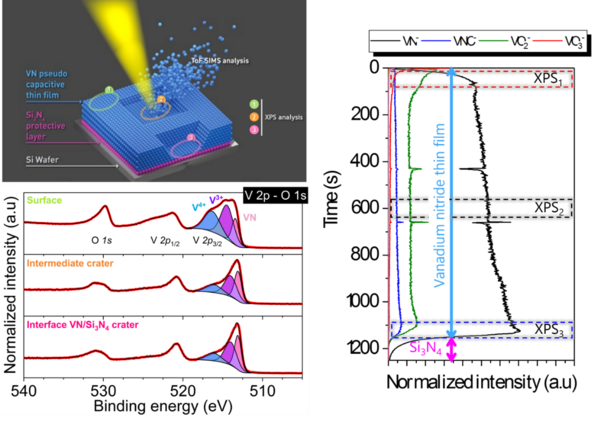
(1) K. Robert, D. Stiévenard, D. Deresmes, C. Douard, A. Iadecola, D. Troadec, P. Simon, N. Nuns, M. Marinova, M. Huvé, P. Roussel, T. Brousse, and C. Lethien, « Novel insights into the charge storage mechanism in pseudocapacitive vanadium nitride thick films, » Energy Environ. Sci. (2020).
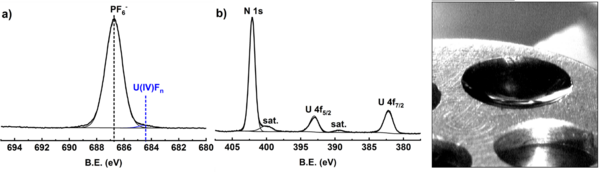
(2) F. Joly, P. Simon, X. Trivelli, M. Arab, B. Morel, P. L. Solari, J. Paul, P. Moisy, and C. Volkringer, « Direct conversion of uranium dioxide UO2 to uranium tetrafluoride UF4 using the fluorinated ionic liquid [Bmim][PF6], » Dalt. Trans. 49, 274–278 (2019).
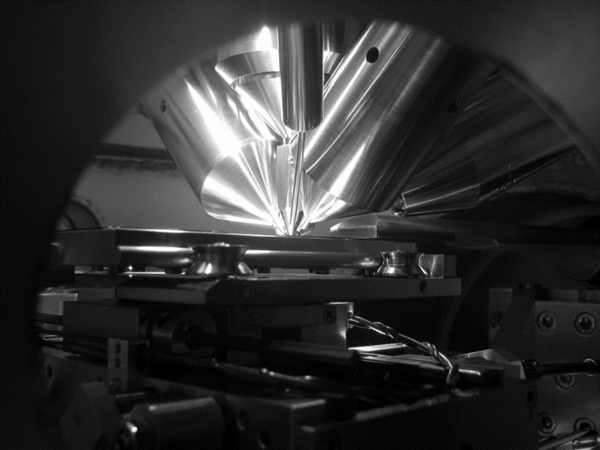
IONTOF – TOF.SIMS5 (2009) instrument
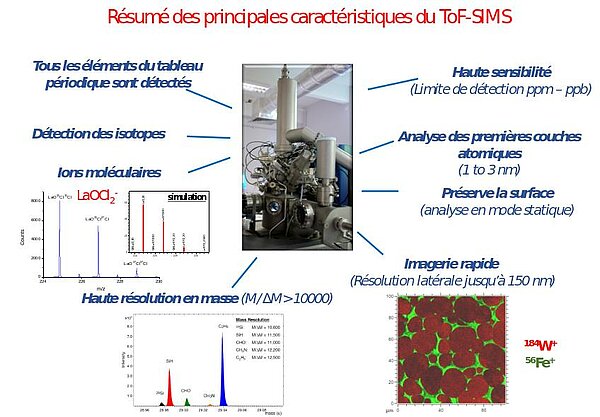
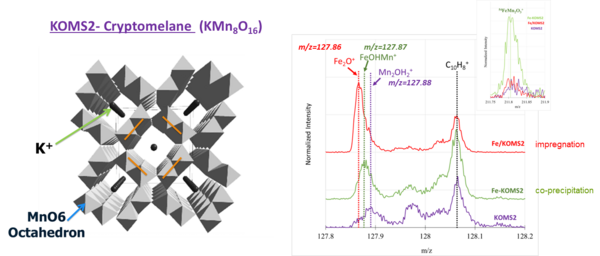
Time-of-Flight Secondary Ion Mass Spectroscopy (ToF SIMS) is a very sensitive analytical technique, for many industrial and research applications. This technique uses a pulsed ion beam (here Bi+) to remove both atoms and molecules from the sample surface (< 4 monolayers). The secondary ions removed from the surface are then extracted and accelerated by an electrical field and their masses are then determinate by measuring their time of flight over the analyzer to reach the detector.
The time of flight analysis allowed a high mass resolution, an unlimited mass range and a parallel detection of all ions.
-
IONTOF – TOF.SIMS5 specifications
– Primary ion beam: Bi+, Bi3+, Bi3++
– Mass resolution: m/∆m > 10.000
– Mass detection: parallel
– Mass range: “unlimited”
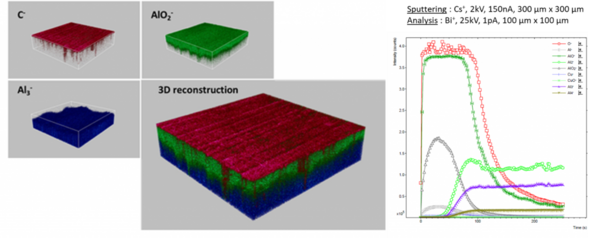
– Analysis Mode: Static SIMS and dynamic SIMS
– Sputter guns: Ar+, Cs+ and O2+ (from 0.25 to 2 keV)
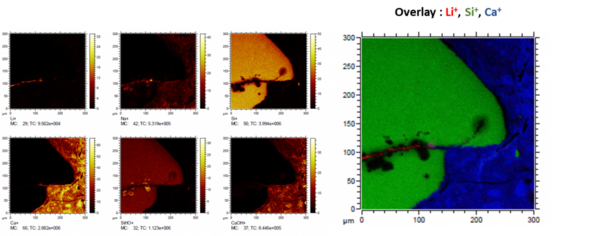
– Lateral Resolution: up to 150nm
– Depth resolution: nm range
All types of samples compatible with ultra-high vacuum can be analysed by ToF-SIMS: polymers, metals, ceramics, organic tissues, catalysts, semi-conductors, drugs ….
Sample preparation: TOF-SIMS analysis does not require any special preparation. However, a surface that is as flat as possible is recommended to obtain good mass resolution. The ideal sample size is of the order of 1 cm2 with a thickness of less than 5 mm. The maximum sample size is 5 cm x 10 cm and the maximum thickness is 1 cm.
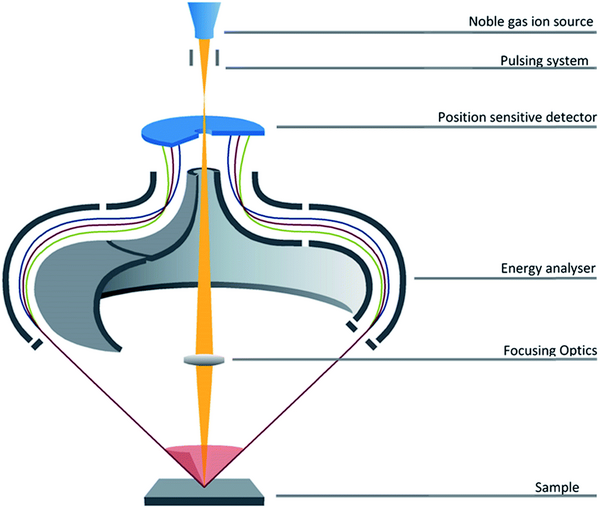
The unique Qtac energy analyser was designed by IONTOF. This analyser has an acceptance over the full azimuth providing a high sensitivity and high mass resolution.
IONTOF – Qtac 100 instrument
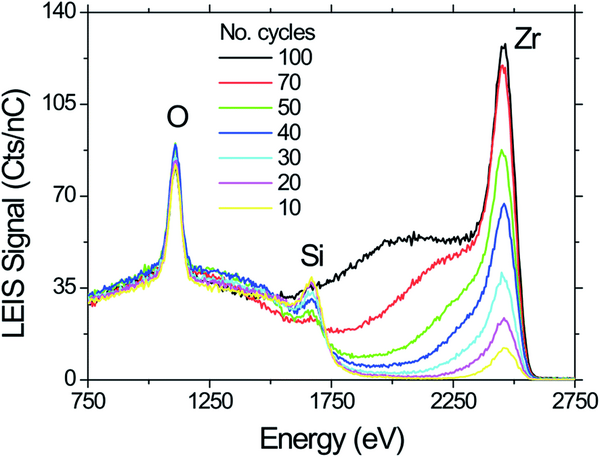
Low Energy Ion Scattering (LEIS) is a surface sensitive analytical technique used to characterize the chemical and structural makeup of materials. LEIS involves measuring the kinetic energy of dispersed ions, after sending a monoenergetic beam of these ions onto a surface to characterise it. LEIS probes the elemental composition of the outermost atomic layer of a material and provides static depth profiles of the outer 10 nm of surfaces. Its extreme surface sensitivity and quantitative nature make it a powerful tool for studying the relationships between surface chemistry and surface related phenomena such as wetting, adhesion, contamination, and thin film growth.
-
IONTOF – Qtac 100 specifications
– Primary ion beam: He+, Ne+, Ar+
– Beam spot size around 10 µm
– Hydrogen and oxygen plasma for surface cleaning
– Typically scan area from 1 x 1 mm2 to 2 x 2mm2 (for negligible damage)
– Time-of-Flight Mass Filter to improve the elemental detection limits.
-
Qtac 100 key features
– 3000 times higher sensitivity than conventional LEIS instrument
– Quantitative, Elemental characterization of the top atomic layer
– Spectroscopy and imaging capabilities
– Analysis of rough and non-conductive materials
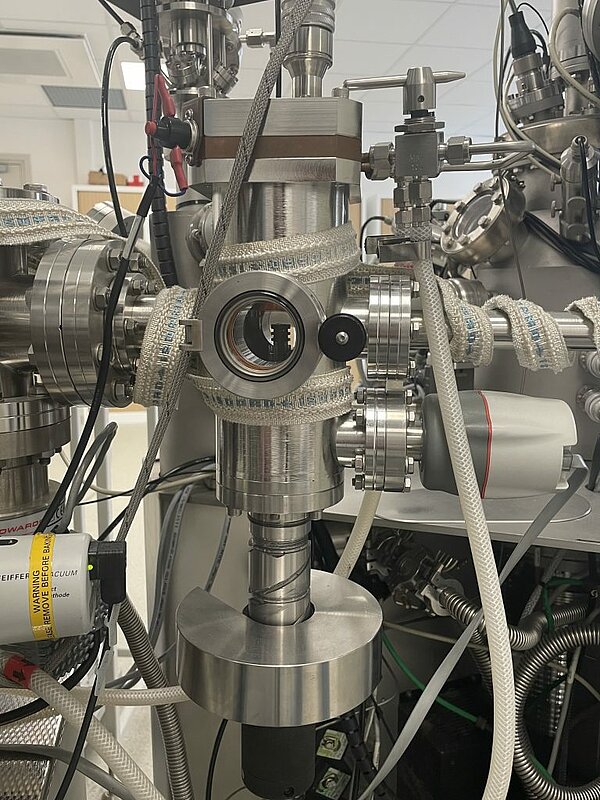
In situ catalysis cell attached to the distribution chamber:
Samples can be treated under reactional stream (H2, CO, NO, O2… or light alcohol vapors) up to 900 °C, then transferred under vacuum towards XPS, ToF-SIMS or LEIS analysis chambers. Possibility to connect a mass spectrometer to analyze the residual gas output.
NAP-XPS:
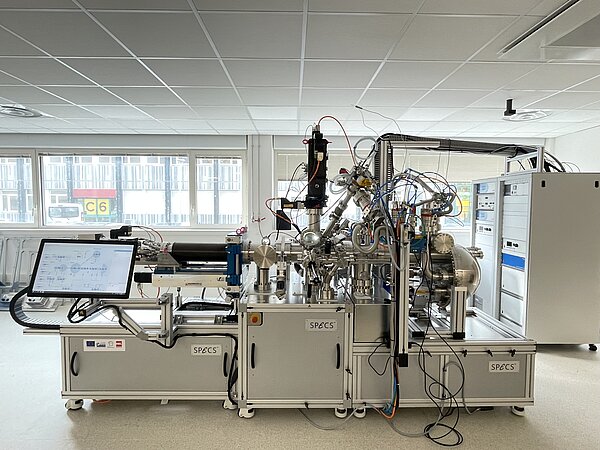
More details will appear as they become available for release on the instrument’s webpage
Events
-
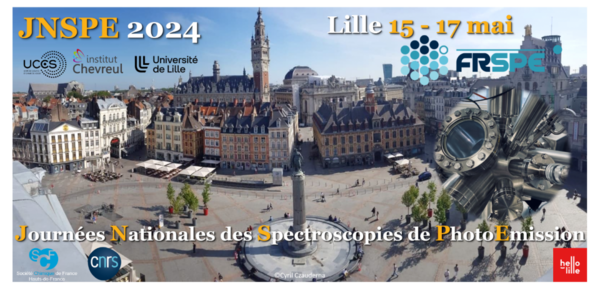
Journées Nationales des Spectroscopies de PhotoEmission 2024 (JNSPE)
The Journées Nationales des Spectroscopies de PhotoEmission (JNSPE) is the annual event of the Fédération de Recherche Spectroscopies de Photoémission (FR SPE 2050).
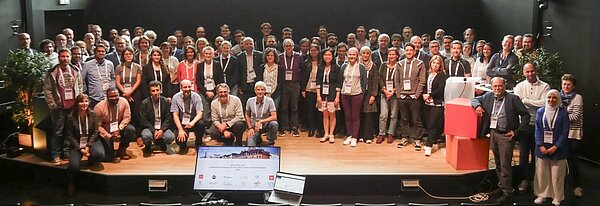
The JNSPE 2024 conference took place from May 15 to 17, 2024 in Villeneuve d’Ascq.
Around 90 people attended.
-
IONTOF Annual ToF-SIMS User’s Meeting 2023
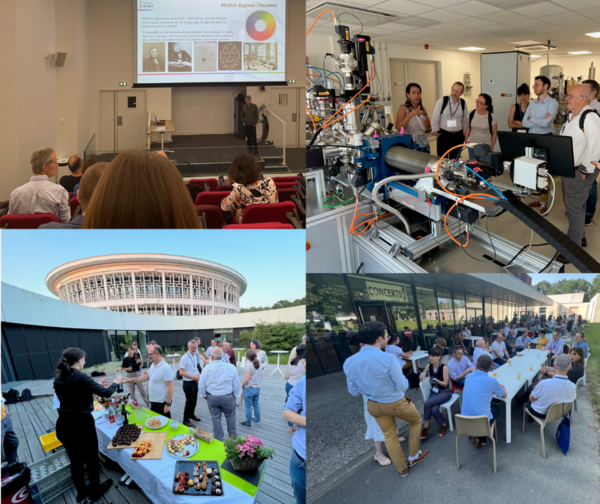
On June 13 and 14, 2023, the Surface Analysis Division hosted the 11th Francophone Day. Around forty participants attended conferences, workshops, and tours of our facility.